Following Damascus ... Karl Ernst Osthaus and the Arts of the Islamicate World
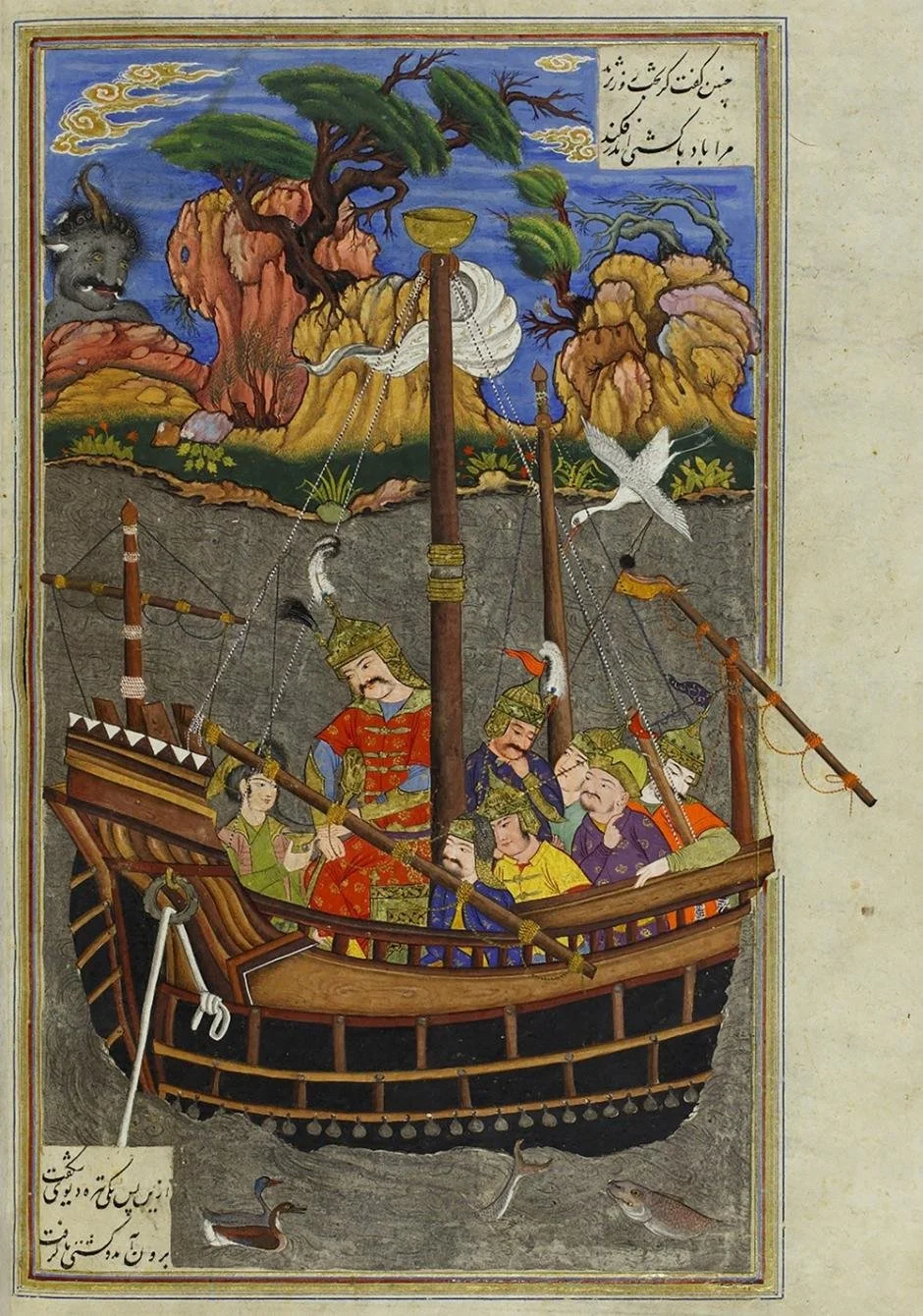
Abū 'l-Qāsim al-Firdawsī, Garshāsp and His Warriors on a Ship (from the Shāhnāma), ca. 1014 AH (1605 CE), Staatsbibliothek zu Berlin – Preußischer Kulturbesitz (Berlin State Library).
A gold-gleaming drinking cup from 13th-century Syria, a 19thcentury Imuhagh weapon, intricately painted tiles, precious textiles and a book full of heroic tales: the exhibition Following Damascus … Karl Ernst Osthaus and the Arts of the Islamicate World takes visitors right to the heart of a section of the Museum Folkwang’s collection that has rarely been exhibited before. The approximately 340 objects on display tell of faraway places, of journeys and encounters, but also of the history of collecting. They originate from regions that today form part of Iran, Syria, Turkey, Egypt and Spain, and span a period from the 4th to the 19th century CE.
Their history is linked to Karl Ernst Osthaus (1874–1921) and his travels to the Maghreb and the Ottoman Empire around 1900. What began as a field expedition turned into a journey that would have a lasting influence on his view of art and architecture. Osthaus collected applied arts from North Africa and West Asia and brought these objects to Hagen. Arts from the islamicate world found their place here even before works by Auguste Renoir or Vincent van Gogh entered the collection.
Some exhibits, now in other collections, are returning to the Folkwang context for this exhibition. Among the most significant loans are a 17th-century copy of the Shāhnāma (‘Book of Kings’), on loan from the Berlin State Library, and the so-called Damascus Room from Dresden. A beam of the original is on display at the Museum Folkwang.
The collection of Islamic art at the Museum Folkwang has, for the first time, been comprehensively researched and restored over the past few years. All the works have been scientifically catalogued and prepared for the exhibition. As part of a pilot project on provenance research, some 2,000 pages of historical material were examined. The exhibition thus offers new insights not only into the objects themselves, but also into the history of their acquisition, research and presentation.
Following Damascus … focuses not only on the history of the collection, but also on the perspectives from which it has been assembled, exhibited and viewed to this day. With her textile installation, contemporary artist Dana Awartani brings issues of our time and a female perspective to the exhibition. A painting by Matisse, a fabric by Peter Behrens, mosaic designs by Johan Thorn Prikker and an architectural project by Bruno Taut are juxtaposed with objects from the Islamicate world. Photographs from the Folkwang publishing house’s archives illustrate just how diverse the Museum Folkwang’s collection, interests and networks have been from the very beginning.