Global Antiquity Cultural Interactions In Afroeurasian Space 600 BCE - 1000 CE
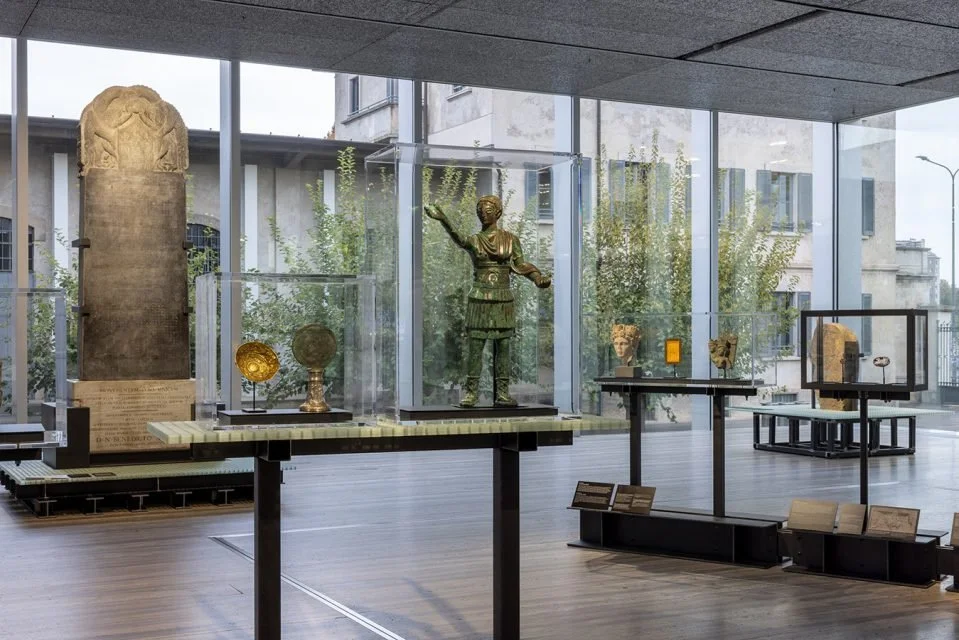
Through an accurate selection of over 150 artworks and artifacts, Global Antiquity offers a unique perspective on the artistic, cultural, commercial, and political ties that, over 1,600 years of history, connected peoples and cultures from the Mediterranean to Asia, across continents and seas. Each of the objects on display, coming from different parts of the world, becomes a narrative element that attests to meaningful connections between two or more geographic regions and societies, often far apart from each other. From this perspective, where an artifact is found is just as important as where it was originally produced. Connecting these points on a world map reveals a multitude of trade routes and political, cultural, economic, and religious ties that extend far beyond the so-called Silk and Spice Roads. The ancient world emerges as a dense and dynamic web of exchange extending across continents.
“Global Antiquity” highlights the close and reciprocal nature of these connections that did not simply develop along linear one-way pathways but formed a fluid and constantly evolving polygonal network. By showcasing unexpected “Mediterranean” presences in Asia, or displaying a female statuette of the Indian subcontinent that arrived in Pompeii before the AD 79 eruption, the exhibition creates a space-time short circuit, prompting us to rethink our view of history and reflect on the present from a long-term perspective.
Two of the project’s underlying themes resonate powerfully in contemporary public debate: the concept of globality—a commonplace and a controversial topic in today’s political and economic discourse—and the complex phenomenon of cultural hybridization.
As Salvatore Settis explains, “This exhibition offers a constellation of exemplary cases, each marked by its own form of cross-cultural interaction but all traceable to a single narrative: the polygonal network of trade and influence that spanned Eurasia, extending beyond its borders and fostering mutual awareness and curiosity on a massive scale. From our atlas of microhistories, a macrohistory thus emerges in which pre-modern globality appears as a state of unstable equilibrium, yet open to countless possibilities.”
The exhibition design, conceived by Rem Koolhaas with Giulio Margheri and the AMO/OMA team, unfolds on the ground floor of the Podium, the main space of the Milan venue. The design translates the curatorial thesis into a series of individual stories, each presented through a display that reflects the different networks of exchange. These displays, made of metal and fiberglass, are organized within a layout that invites visitors to explore the exhibition’s artworks and artifacts according to principles of convergence, symmetry, intersection and migration.
The exhibition is part of a wider investigation undertaken by Fondazione Prada since 2015, when it simultaneously presented “Serial Classic” and “Portable Classic” in its Milan and Venice spaces, two exhibitions curated by Salvatore Settis (with Anna Anguissola in Milan, and Davide Gasparotto in Venice). The research continued in 2022 in Milan with “Recycling Beauty” (curated by Salvatore Settis and Anna Anguissola with Denise La Monica), a project dedicated to the reuse of Greek and Roman antiquities in post-antique contexts, from the Middle Ages to the Baroque era.
The underlying premise of this comprehensive survey is the desire to think of ancient art not simply as a legacy of the past, but also as a vital element with the power to affect our present and future. Such themes as seriality, reuse, recycling, and globality are closely linked to our conception of modernity, but they also attest to the extraordinary persistence of certain values, categories, and models of the past. Through an innovative curatorial approach and experimental exhibition formats developed by Rem Koolhaas and AMO/OMA, ancient heritage becomes, in Salvatore Settis’ words, “a key that provides access to the multiplicity of cultures in the contemporary world.”