Henri Rousseau, A Painter's Ambition
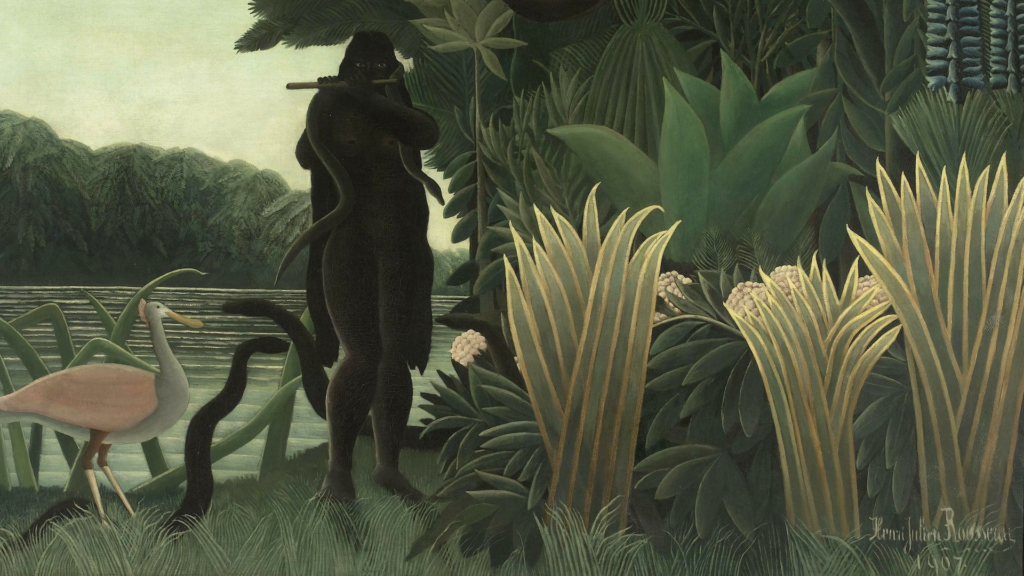
Henri Rousseau, La Charmeuse de serpents, 1907, Musée d'Orsay. Legs Jacques Doucet, 1936
© Musée d’Orsay, dist. GrandPalaisRmn / Patrice Schmidt
Henri Rousseau, A Painter’s Ambition looks back on Henri Rousseau’s career (1844-1910), his approach to painting, and his professional ambitions through his connections to the art market. At the age of 49, he moved to Paris from his native hometown of Laval and decided to retire from his job as a customs officer to devote himself entirely to painting. The artist used a range of genres and techniques to make a name for himself on the Parisian art scene: compositions sent to the Salon des Indépendants, government commissions to decorate town halls in the Île-de- France region, portraits commissioned by his friends and family, landscapes intended for sale, and more intimate self-portraits. The exhibition aims to go beyond the legends surrounding the name of ‘Le Douanier Rousseau’ (Rousseau the toll collector) to study his artistic career in depth. Thematic areas will explore the artworks’ materiality and study them in the context of the modern art market, in which Paul Guillaume and Albert Barnes were key figures.
Bringing together the two largest collections of the artist's work - the Musée de l'Orangerie in Paris and the Barnes Foundation in Philadelphia - as well as major works from international public collections, provides an opportunity to study the materiality of an entire corpus, with recent scientific analyses carried out by the Barnes Foundation shedding new light on the artist's painting technique. In parallel, the Orangerie collection has been entrusted to the Centre de Recherche et de Restauration des Musées de France (French museums’ centre for research and restoration - C2RMF) rounding off this ensemble and studying its coherence in terms of the techniques and materials used. The scientific analysis will be presented in an digital display, giving the public a more practical insight into the materiality of these artworks and revealing Rousseau's creative process.
Looking at the history of these two institutions, this collaboration makes perfect sense: Paul Guillaume, whose collection is the centrepiece at the Paris museum, acted as an intermediary for Albert Barnes when he purchased eighteen of Rousseau’s paintings. He was himself an avid collector of Rousseau’s work and owned up to fifty paintings by the artist, according to the documentary albums kept in the museum's archives. Nine of these are now held in the Musée de l'Orangerie's collection, along with two small portraits acquired recently. The exhibition and its catalogue will look back on this close collaboration between the Parisian dealer and the American collector, and more broadly on the network of collectors and dealers the painter worked with during his lifetime. Around fifty works will be on display, some selected from these two institutions’ collections and others key artworks on loan from European and American institutions, including The Sleeping Gypsy, a masterpiece conserved at the Museum of Modern Art in New York.