Juste-Aurèle Meissonnier Tags For: Juste-aurèle Meissonnier Special Exhibition Featured Rococo Goldsmith in Focus
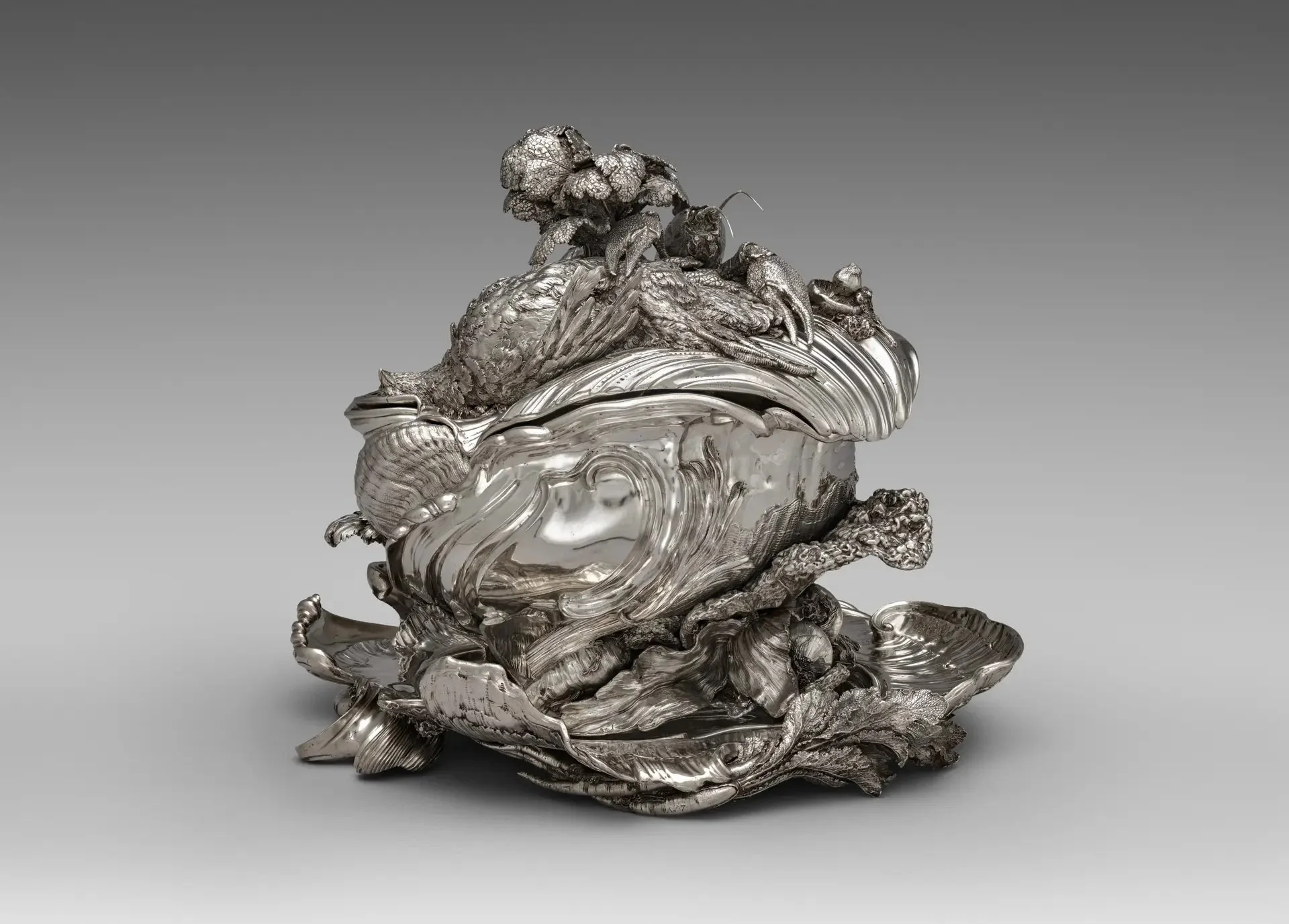
Juste-Aurèle Meissonnier, Pierre-François Bonnestrenne , Henry Adnet , Covered Tureen on Stand (Pot-à-oille), 1735–38, The Cleveland Museum of Art, Leonard C. Hanna Jr. Fund, 1977.182
Juste-Aurèle Meissonnier (French, born Italy, 1695–1750) was the most revolutionary forerunner of the Rococo style in the decorative arts. Multitalented with entrepreneurial skills, he worked for the French court and European nobility. Considered a genius goldsmith by his contemporaries, he was also a prolific designer and aspiring architect, seamlessly maneuvering between media and disciplines.
Born and trained in Turin, Italy, he moved to Paris around 1715 to advance his career, although the conservative guild of Parisian goldsmiths made it practically impossible for newcomers to register as masters and open their own workshops. Meissonnier’s ambition, creativity, and determination in pursuing his desired career path are apparent from his work and limited biographical information and continue to resonate today.
Few of his works survived political upheavals; the most celebrated is a silver tureen in the collection of the Cleveland Museum of Art, made for the 2nd Duke of Kingston. A striking sculpture rather than a functional object, the tureen epitomizes the Rococo style with its movement, asymmetrical design, fluid unity of form and ornament, and elements inspired by nature. The tureen has recently undergone scientific analysis, which has provided new insights into its sophisticated creation process.
For the first time, a core group of objects designed by Meissonnier is displayed together, including a recently acquired remarkable gold box made for the queen of Spain, which has never been shown in a museum, and important loans from the Louvre and the Museum of Decorative Arts in Paris: a ewer, or pitcher, that belonged to the French Queen Marie Antoinette, and a candelabrum made for Evelyn Pierrepont, 2nd Duke of Kingston-upon-Hull, who also commissioned the CMA’s tureen.
Accompanied by a lavishly illustrated publication, this exhibition offers a fresh perspective on an artist who deserves broader recognition.