The Renaissance Engraver at Work
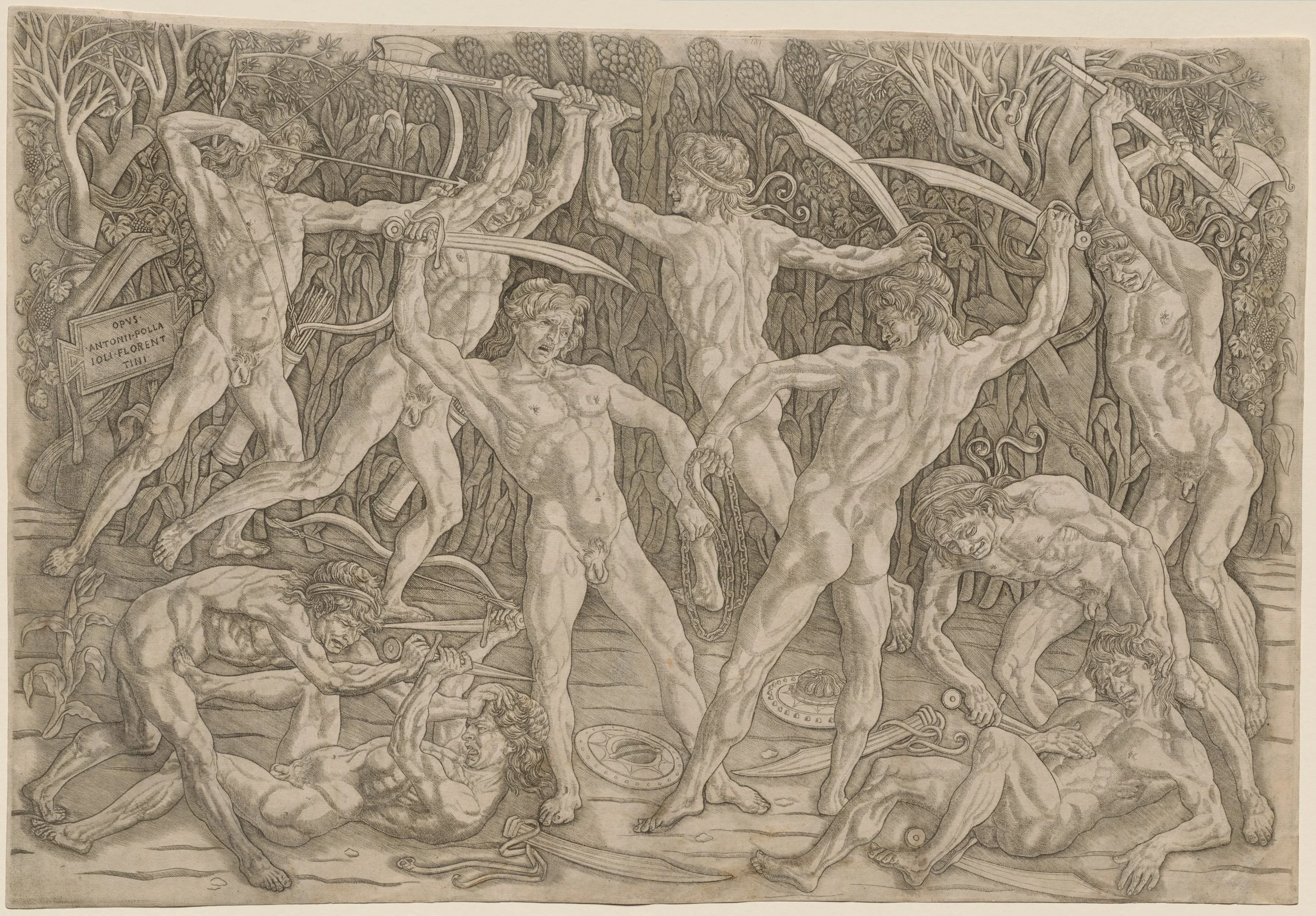
Antonio del Pollaiuolo, Battle of the Nudes, 1470s–80s, The Cleveland Museum of Art, Purchase from the J. H. Wade Fund, 1967.127
Many of us hold an engraving in our hand every day in the form of US currency. In Renaissance Europe, engraving was a new technology. Long the domain of goldsmiths, engraved lines appeared as prints on paper—possibly to record metalwork designs—in the mid-1400s. The potential of printed engravings quickly became clear: They provided the opportunity to reproduce artworks in other media with unprecedented refinement and to disseminate artistic compositions far and wide.
Engraving’s materials are unforgiving. Made with just a burin (a steel chisel), a copperplate, ink, paper, and a press, engraved designs are limited to a visual vocabulary of crossed and parallel lines, dots, and grooves. Engravings made between approximately 1470 and 1650 reveal how early practitioners grappled with universal pictorial problems—such as tone, texture, and volume—through linear means. The Renaissance Engraver at Work follows the rapid spread of engraving, marked by key innovations, from the Rhine region to Florence, Nuremberg, Venice, Antwerp, Rome, and Paris.
The Cleveland Museum of Art holds some of the world’s rarest and most important early engravings, including the only known first state of Antonio del Pollaiuolo’s Battle of the Nudes and unique impressions by Master of the Nuremberg Passion and Master of the E-Series Tarocchi. Drawn entirely from the CMA’s collection, The Renaissance Engraver at Work explores the innovations and adaptations as well as the beauty and astounding optical effects that shaped the early history of engraving.