Titian and Landscape
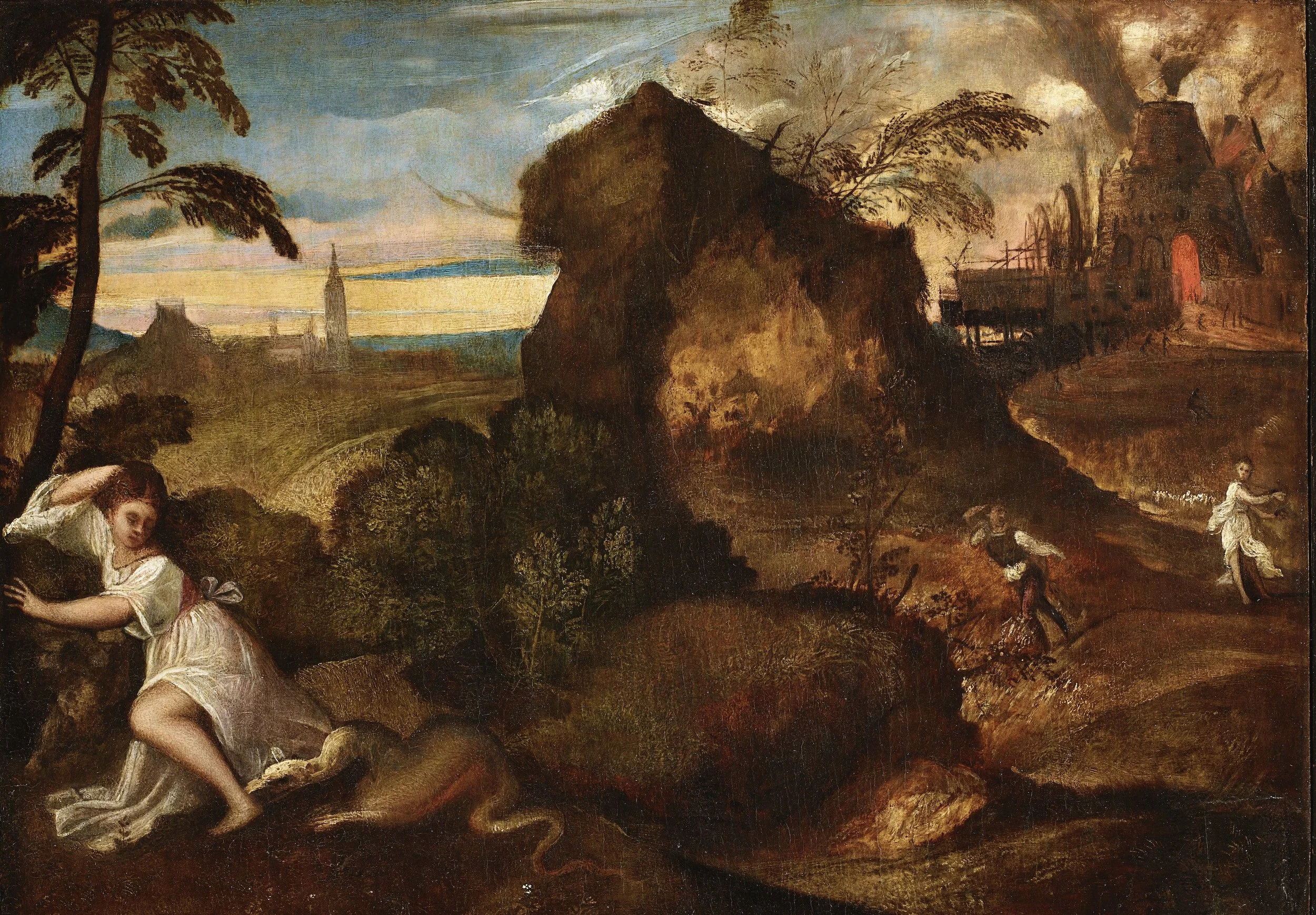
Titian, Orpheus and Eurydice, between circa 1508 and circa 1510, Accademia Carrara.
Celebrating the 450th anniversary of the painter's death (in 1576),Titian and Landscape is the second project by the Magnificent Community of Cadore aimed at exploring his revolutionary role in the birth of modern landscape painting in Titian's practice and poetics. The project intends to pose new questions and investigate, with a different critical approach, a phenomenon that had an enormous impact on visual culture.
Later, and not only in Italy. Curiously, landscape is one of the least explored aspects of Titian's work, although it is perhaps one of the most significant in his poetics. In addition to the human figure, other elements drawn from the natural environment also appear in Titian's paintings and works on paper. Mountains,
Rocks, hills, streams, trees, varied vegetation, meadows, houses, castles, fortresses: in short, what we define in a word as "landscape." Titian, however, is not the first painter to include landscape in his paintings; important artists from Northern and Southern Europe had preceded him: Jan van Eyck, Hans Memlinc, Andrea Mantegna, Cosmè Tura, Giovanni Bellini, Cima da Conegliano and many others. However, it is evident that the vision of nature, in the images of the Cadore area, appears transformed compared to
In these models, it takes on new atmospheric qualities and a different role in the pictorial fabric, as the figures are harmoniously integrated into the natural context rather than positioned in front of the landscape. Examples of this new approach abound in Titian's pictorial oeuvre, from his early works to his mature production.
Starting from these premises, the exhibition has three main objectives. First, it seeks to understand how landscape contributes to the construction of meaning in Titian's figurative works. Second, it seeks to understand whether landscape in the work—not only paintings, but also engravings and drawings—of Titian and his direct collaborators and followers should be considered a sort of revolution, preparatory to the affirmation of an autonomous genre. Finally, it aims to sketch a brief and previously unpublished profile.
It also looks the impact of the Titian/Campagnolesque landscape model on the broad panorama of European landscape art up to the eighteenth century. These three objectives are variously addressed in the three sections into which the exhibition is divided, which are titled: Origins, Elaboration, and Diffusion.
The exhibition features three extraordinary paintings by Titian (THE BAPTISM OF CHRIST from the Capitoline Museums, ORPHEUS AND EURYDICE from the Accademia Carrara in Bergamo, and SAINT JOHN THE BAPTIST from the Gallerie dell'Accademia in Venice) and 30 graphic works (based on his drawings or those of precursors and heirs to his style, including Dürer, Cranach, Rembrandt, Watteau, and Marco Ricci). Furthermore, the painter's birthplace is hosting a related exhibition of Josiah Gilbert's watercolors of the Cadore landscapes that inspired the artist.