Winslow Homer: Painter, Etcher
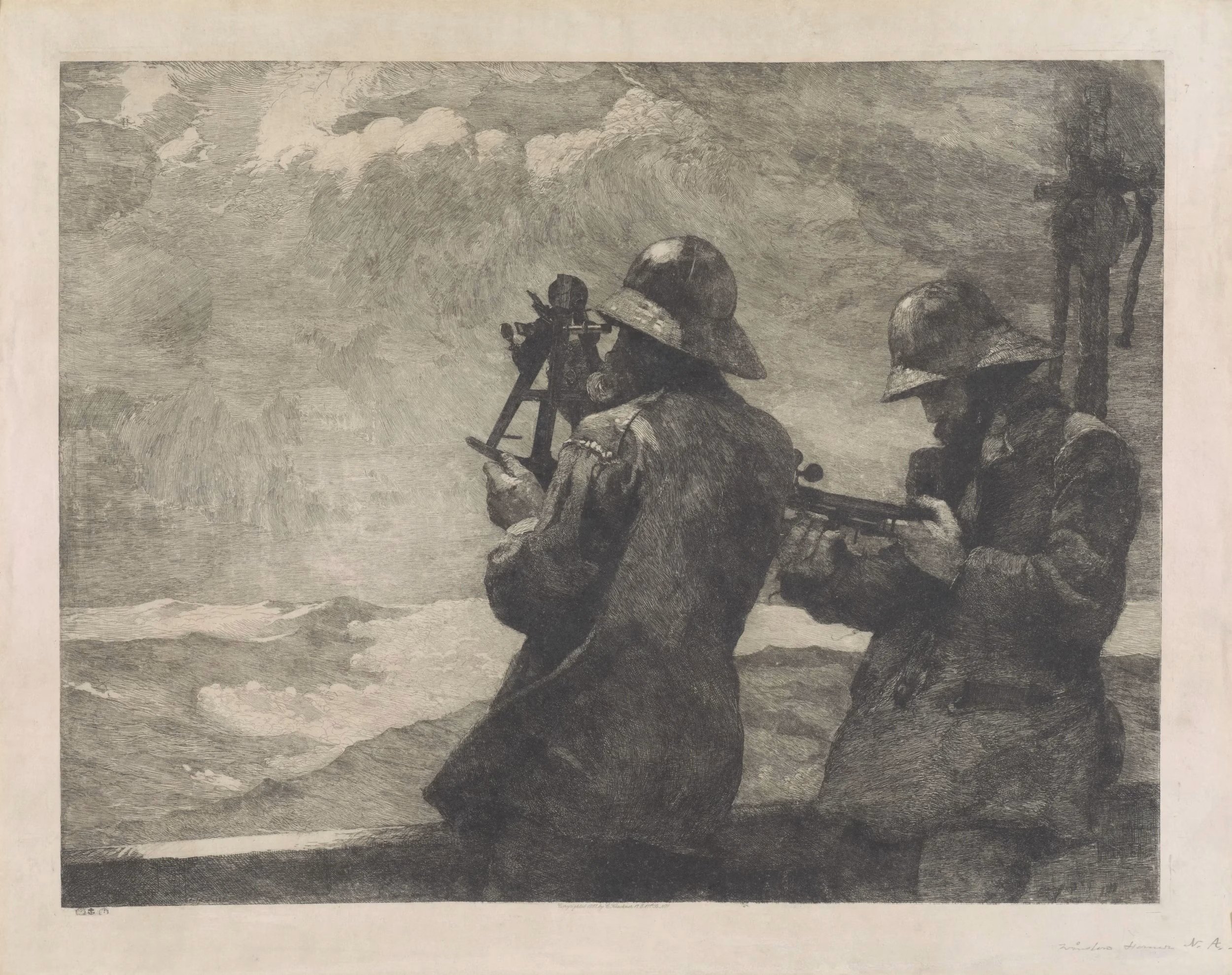
Winslow Homer, Eight Bells, 1887, Portland Museum of Art, Maine.Museum purchase with support from the Peggy and Harold Osher Acquisition Fund and partial gift of Mr. and Mrs. Vaughan W. Pratt, 2014.3. Image courtesy Pillar Digital Imaging
Winslow Homer (1836–1910) is celebrated for his powerful paintings and watercolors, yet in the 1880s he turned to etching to revisit some of his most iconic subjects.
From his studio at Prouts Neck, Maine, now preserved and interpreted by the Portland Museum of Art, Homer collaborated with New York printer George W. H. Ritchie to produce a concise but striking series of prints that reveal his technical mastery and his continued fascination with the sea and wider natural world.
Winslow Homer: Painter, Etcher presents these rare etchings in dialogue with related paintings, drawings, and proofs, offering visitors the opportunity to see how Homer’s Maine studio influenced his process and compositional choices. Through careful display, the exhibition evokes the environment where these prints were conceived, connecting audiences to the physical and creative context of Homer’s work.
The exhibition highlights Homer’s role in exploring the circulation of images in late nineteenth-century America while shedding light on a practice the artist himself regarded among his finest achievements. As steward of the Winslow Homer Studio and a landmark collection of his work, the PMA is uniquely positioned to foreground this pivotal chapter in the artist’s career.
A fully illustrated catalogue, the first comprehensive study of Homer’s etchings, will accompany the exhibition, co-published by the PMA and Yale University Press