Asta Nørregaard: Truth and Beauty
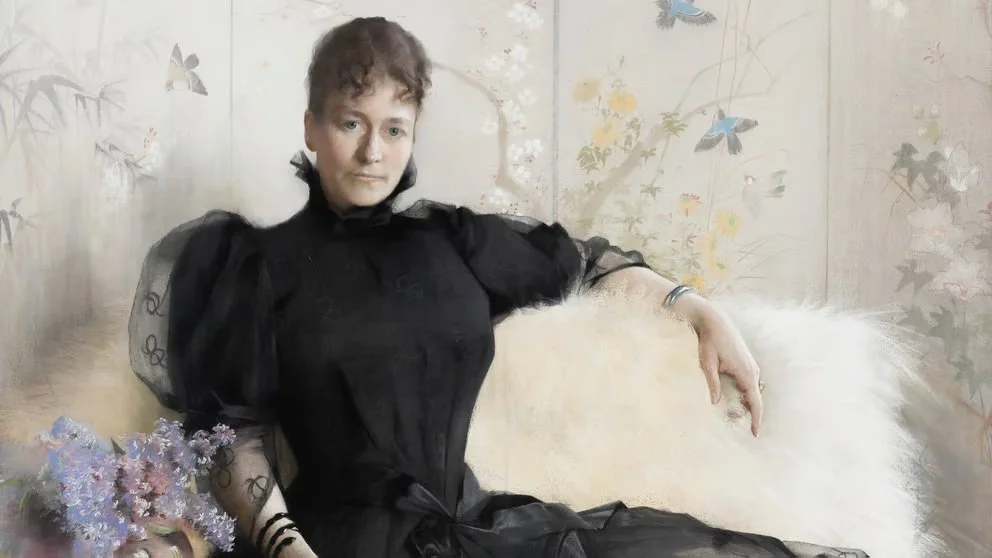
Asta Nørregaard, Portrait of Elisabeth Fearnley (detail), 1892, The National Museum, Oslo. Photo: Øystein Thorvaldsen
This exhibition, devoted to Asta Nørregaard,explores the full breadth of the artist’s work. The focus is on portraits, pastels and fashion, but there are also paintings on religious themes, evocative landscapes and detailed interiors.
It was no accident that Asta Nørregaard became known as the ‘fashion painter’ of Norwegian art. She had an eye for costume, fashion and accessories, and excelled in the rendering of velvet, silk and lace. Her subjects confront us with vivid expressions and depths of personality and character. Edvard Munch, Katti Anker Møller and Elisabeth Fearnley are just some of the many whose portraits Nørregaard painted.
Although her reputation was built on portraits, Nørregaard also painted landscapes, interiors and biblical scenes. Her evocative breakthrough painting "Waiting for Christ" earned her a prestigious commission to paint an altarpiece for Gjøvik Church. The exhibition presents a number of her religious works.
Nørregaard fought for her freedom as an artist and refused to let social norms determine her life. Despite the limited opportunities for women in the field of art, she received a solid training in Christiania, Munich and Paris. During her art studies, she met Harriet Backer and Kitty Kielland, with whom she later shared an address at Hansteens gate 2. Nørregaard also started her own school of painting and set up endowment funds to support women artists.
For many years, Nørregaard was overshadowed by more famous contemporaries, but recently she has gained recognition as a substantial force in Norwegian art history. The exhibition shows many of her major works from the late 1870s through to the 1920s, with an emphasis on the period around 1900.
The exhibition includes rarely exhibited paintings, pastels, drawings, sketchbooks and archival materials. It includes treasures from the National Museum’s collection and works generously loaned by, among others, the Munch Museum, Oslo Museum, the University of Oslo, Stamhuset Jarlsberg and many private owners.