Renoir and Love A Joyful Modernity (1865-1885)
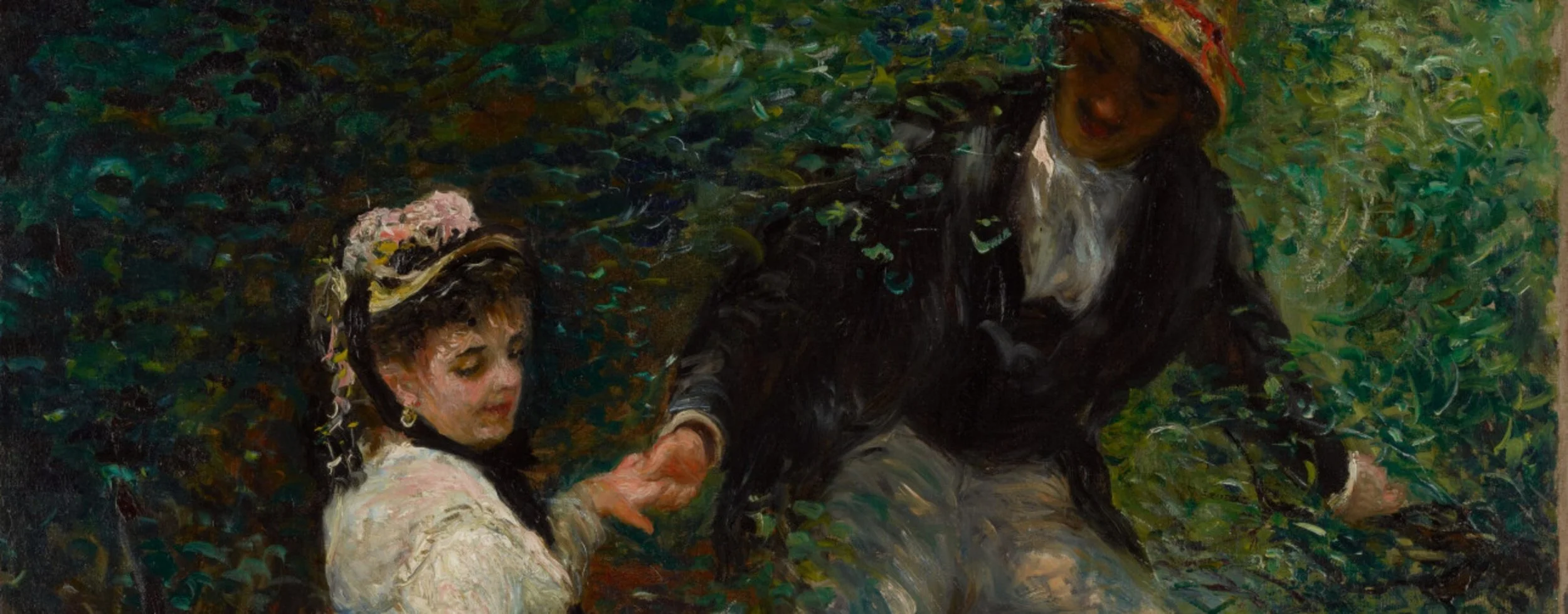
Pierre-Auguste Renoir, La Promenade (detail), 1870, © Image courtesy of the J. Paul Getty Museum
A major figure in impressionism, Pierre Auguste Renoir, like Manet, Degas, Monet and Caillebotte, is regarded as one of the 19th century’s great painters of modern life. Between the mid-1860s and the 1880s, he developed a light, fluid manner of painting, bursting with light and color, along with new subjects focusing on relationships between men and women.
Renoir’s joyful, discreet and tender vision, devoid of any hint of sentimentality, ribaldry or drama, distinguishes him from the other painters of his day. The artist locates the interactions he depicts in his paintings in the public space, the new, modern social and natural settings – theaters, restaurants, guinguettes, boulevards and gardens – frequented by various social classes. Theses popular “scenes” of modern love encouraged greater freedom of morals and the blossoming of “illicit” loves, in an era when bourgeois conventions and religious morality still governed romantic and sexual relationships. Although his depictions were still marked by traditional gender stereotypes, Renoir revived the memory of Watteau’s, Boucher’s and Fragonard’s “fêtes galantes” [courtship parties] in order to re-enchant relationships between men and women and, implicitly, examine the question of male desire and female consent.
But Renoir did not stick to seduction games. His couples are often part of a vast network of social and emotional interactions (friends, parents, children, etc.). Love, understood as a fundamental force binding human beings to each other and to nature, guided his inspiration. According to him, “a picture should be a pleasant thing, joyful and pretty”. His eye and his brush connected actions, looks, bodies and settings in compositions that are worlds in themselves. During this decisive period, he made several attempts at large-format paintings, with scenes of modern conviviality (including Mother Anthony’s Cabaret, Dance at the Moulin de la Galette and Luncheon of the Boating Party), which were so many manifestos and protests against the growing loneliness of urban existence. Refusing to countenance the social determinisms and pessimistic eye that various naturalistic artists brought to the working classes (which he himself came from), by the same token he also avoided a darker reality that included poverty, alcoholism, prostitution and bourgeois male predation on working-class women, and the lot of unmarried mothers and abandoned children… unless he made discreet allusions to these realities he was so well aware of?
This exhibition, co-organized with the National Gallery in London and the Museum of Fine Arts in Boston, reexamines Renoir’s fundamental contributions to impressionism and 19th-century art history through the complex, universal notion of love, the central driving force of his work. It provides a new perspective on paintings that are so well-known that it has become difficult to perceive how radical they are. For the first time since 1985 (the year the last Renoir retrospective was held in Paris, at the Grand Palais), some of the artist’s and impressionism’s greatest masterpieces will be brought together in France.