Renoir Drawings
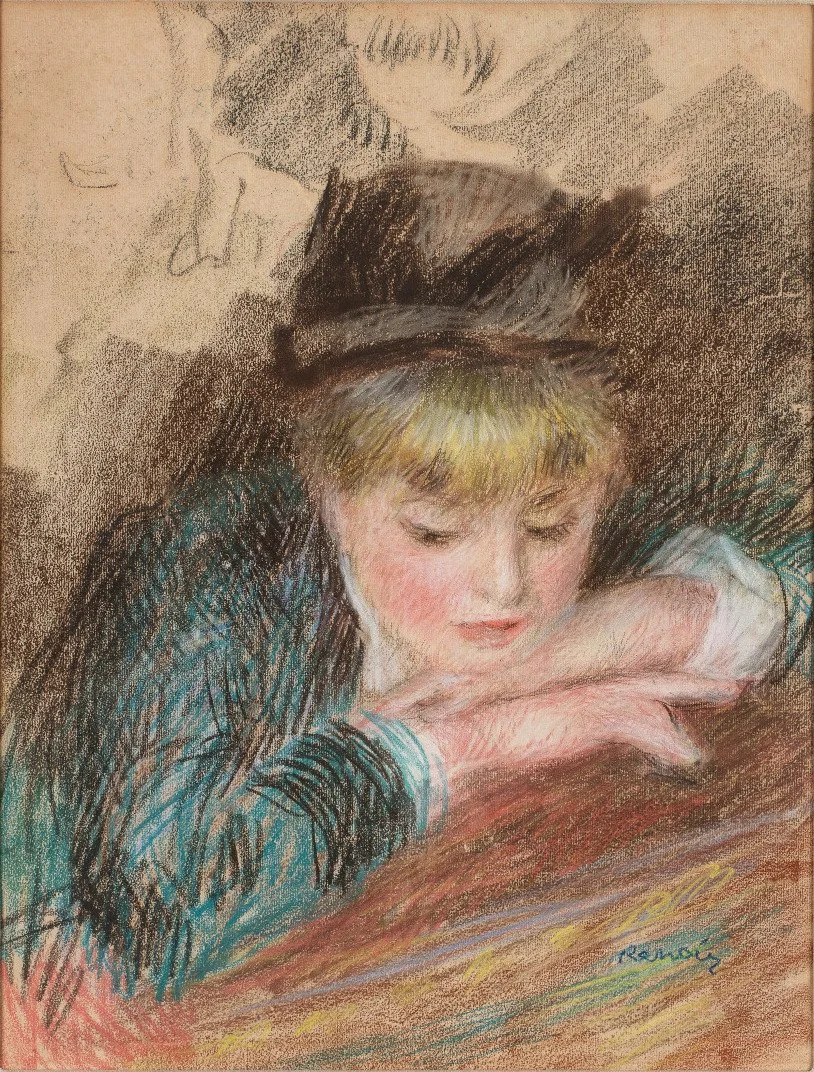
Pierre-Auguste Renoir, Jeune femme penchée sur un balcon, dit aussi La Loge, 1879
© © 2023 Fondation Bemberg / Mathieu Lombard
This is the first exhibition to be dedicated to Renoir’s drawings, and highlights the importance of graphic techniques in his artistic development. It also reveals the close relationship between his paintings and his drawings, in particular from the 1880s onwards when he began to move away from Impressionism.
Although Renoir’s paintings remain icons of impressionism, until now his works on paper (drawings, watercolors, pastels, etc.) have not received the same attention. It is true that the artist, who is recognized above all as a very great painter and colorist, long suffered from a reputation as a poor draftsman. It is also true that his corpus of graphic works is small (Renoir doubtless destroyed many of his drawings) and heterogeneous, including sketches, studies for painted compositions, large-scale tracings, plein air watercolor “notations”, actual portraits in pastel, signed, exhibited and sold to art lovers, and drafts for prints and illustrations. Yet drawing played a decisive role in Renoir’s artistic development, from his first exercises as a student in the 1850s and 1860s to his highly contemporary experiments in the 1910s.
This can be seen in works such as Les Baigneuses. Essai de peinture décorative [The Bathers, decorative painting experiment] and Maternité, where he produced numerous studies in order to achieve the perfect form.
“[Renoir] is a first-rate draughtsman; it would be interesting to show the public all of these preparatory studies for a single painting, as they generally imagine that the Impressionists work in a most nonchalant fashion.” (Berthe Morisot)
The idea for this exhibition, which will feature some 100 works from around the world, including previously unseen sketches and several paintings, is to enter the inner world of the artist’s creative process, focusing on his exploration of light, form and color.
It will also be an opportunity to admire the unexpected ease and great freedom with which the artist approached a wide variety of techniques, including graphite, Conté crayon, charcoal, pen and ink (black and red), pastels, watercolors, and gouache. Particular attention will be paid to sanguine, a technique that, for various reasons (the flow and thickness of the line, the red color associated with flesh and nudes, references to the 18th-century masters Renoir admired), became the artist's preferred medium from the 1880s onwards. At the beginning of the 20th century, these works gained admiration from many artists, including Bonnard (“Bonnard speaks with unfeigned modesty [...] of Renoir's drawing, which he believes himself incapable of achieving”, wrote Thadée Natanson) and Picasso, who owned one of Renoir's most spectacular sanguine drawings.
This exhibition is co-organized with the Morgan Library & Museum.