Unicorns!
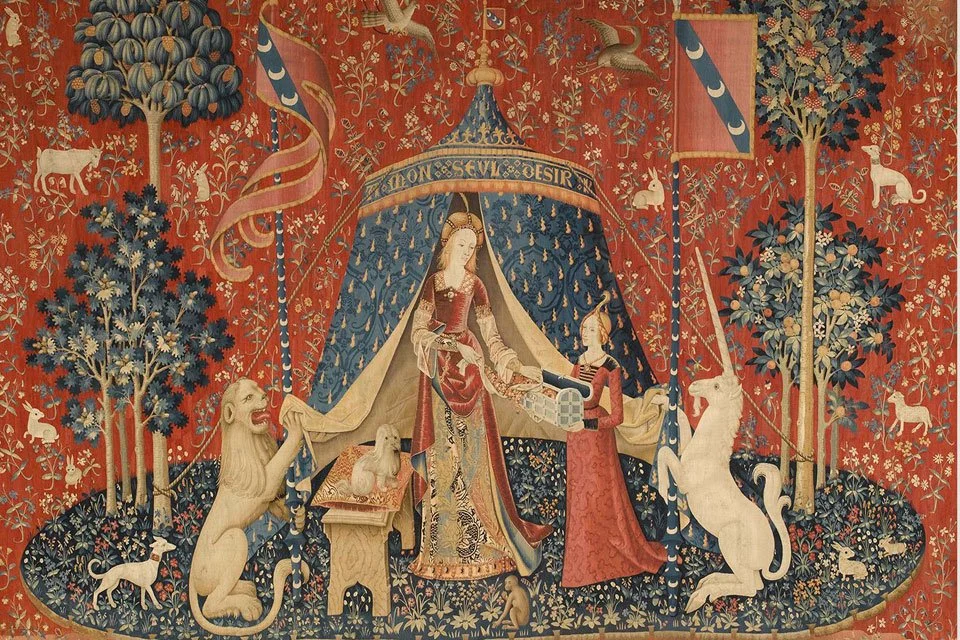
Flemish tapestry workshop, The Lady and the Unicorn: À mon seul désir, ca. 1484-1500, Musée national du Moyen Âge, Paris
Although a mythical creature, the unicorn was long considered real. This inaccessible, untamable, and extraordinary animal has inspired artists since Antiquity. Marco Polo himself claimed to have encountered one during his journey in Asia. While the modern era is resigned to admitting its legendary nature, the unicorn remains present in the imagination of young and old and has left deep traces in the history of art.
The Musée de Cluny, where the famous tapestries of The Lady and the Unicorn are on display, provides an ideal setting to discover them. The exhibition, composed of 10 thematic sections, revisits the multiple aspects of the unicorn through around a hundred works. A universal creature, the unicorn can be found on an engraved seal in the Indus Valley around 2000 BCE; in China during the Han Dynasty (sculpted Qilin around 206–220); or on a 17th-century earthenware dish from Turkey (Dish with Unicorn, Stag, and Lion). At the end of the 15th century, Bernhard von Breydenbach, Canon of Mainz Cathedral, described it among the exotic animals he encountered during a pilgrimage to the Holy Land (Le saint voyage vers Jérusalem). The unicorn can be both wild, as on a silver Torah crown from 1778, and a healer, as its horn is endowed with purifying virtues. Thus, the «Danny Jewel» conserved at the Victoria and Albert Museum was created around 1550 to contain a fragment of unicorn horn—in reality, a narwhal tusk—to be put in contact with food as a precaution against poison.
While the unicorn is sometimes aggressive and unsettling, as on an aquamanile conserved at the Musée de Cluny, it can also be tender and amorous, as in a Venetian oil on canvas from around 1510 (Woman and Unicorn, conserved at the Rijksmuseum). The fantastic creature takes on many symbolic meanings. It is present in Christian iconography, where it inhabits Paradise. In many works from the Middle Ages, it symbolises Christ coming to draw strength in the bosom of his mother, as in a glass painting at the Musée de Cluny where a young girl accompanied by a unicorn surmounts a scene of the Virgin and Child. It also represents the unhappy lover, betrayed by his mistress during the hunt for the unicorn. Both virginal and erotic, the unicorn in the Middle Ages was invested with different meanings that today seem contradictory to us but were not considered so in the medieval era. The fascination with the unicorn was translated in the Modern Era into the cabinets of curiosity of princes or adorned the furniture of grand residences. Rosenborg Castle in Copenhagen conserves a tankard, made after 1656 from a narwhal tusk and decorated with small silver unicorns. These objects entered the cabinets as exotic elements, at the very moment when scientists and naturalists were demystifying the myth of the unicorn’s horn and understood that it was, in reality, a narwhal tusk.
Today, the unicorn remains a particularly inspiring figure and the subject of numerous claims, to the extent of being represented on a 2020 Ukrainian emblem conserved at the Museum Barberini in Potsdam as a queer symbol. The unicorn is thus carried as a standard for the defence of the values of inclusion and minorities, against the discriminatory policies of the Russian enemy. It is the object of reinterpretation by contemporary artists, who see in it an animal that exalts the place of women or raises the question of our relationship with nature and ecology. The exhibition thus features a Unicorn by Niki de Saint Phalle and also Suzanne Husky’s tapestry, La noble pastorale, largely inspired by The Lady and the Unicorn tapestries, a masterpiece of the permanent collection of the Musée de Cluny. The exhibition «Unicorns!» is organised by the Musée de Cluny and the GrandPalaisRmn, with the Museum Barberini in Potsdam. It benefits from loans from prestigious international museum institutions such as the Rijksmuseum in Amsterdam, the Museo Nacional del Prado in Madrid, the Victoria and Albert Museum in London, the Kunsthistorisches Museum in Vienna, and the Musée du Louvre.